LevelUp Casino mobile web app and browser play
 Available in AU
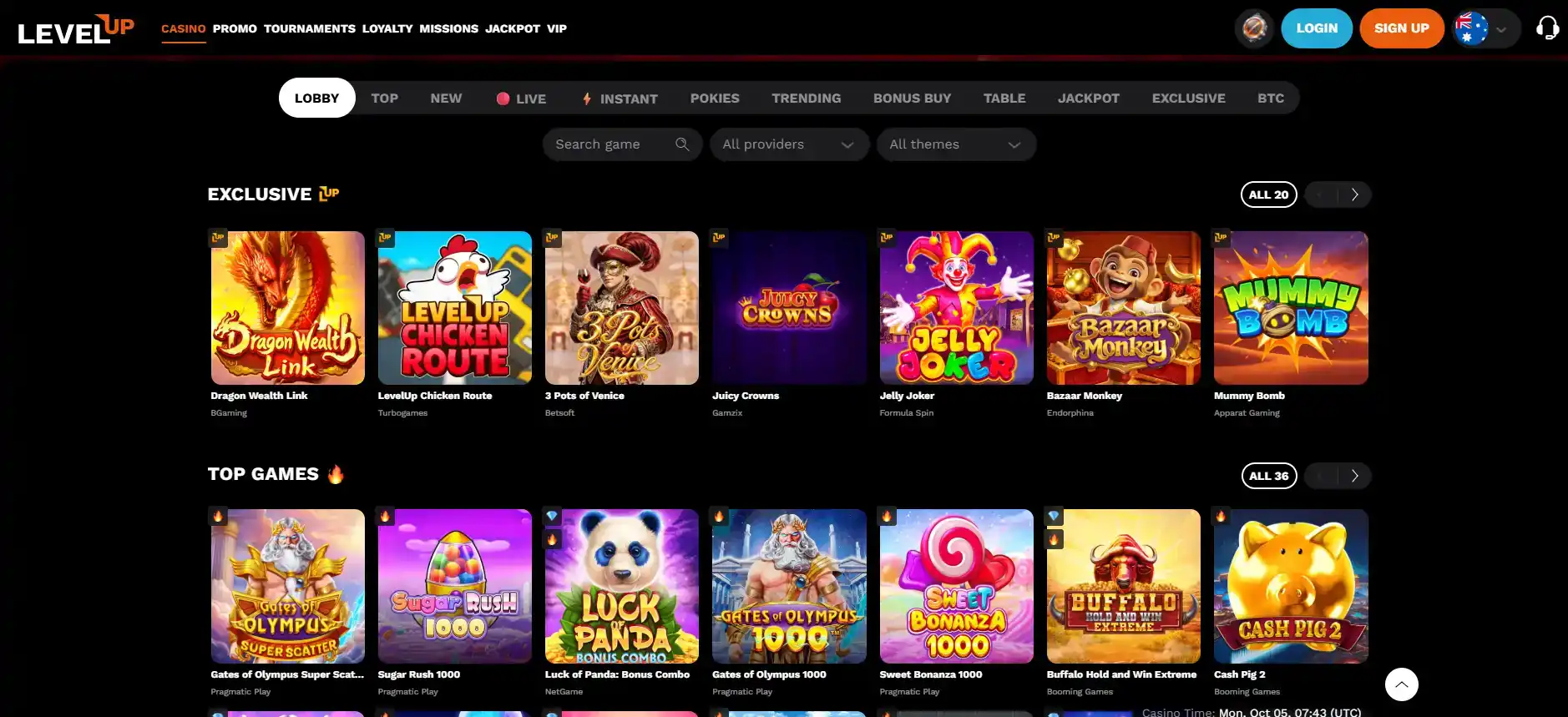
LevelUp Casino has a mobile-app entry in its product navigation. The mobile offering includes a downloadable web app for iOS and Android, while browser access is also available. Both are ways of viewing an online service on a phone, but they have different implications for device privacy, stored sessions and how easily a user can leave the screen. A downloadable web app is a particular description of the mobile experience; the term refers to the web-app format rather than a separate native software category.

LevelUp combines slots and live tables with a multi-currency account and both conventional and cryptocurrency payments. On a phone, that variety puts several different tasks behind a compact interface. Reading a balance, examining a transfer address and starting a game require different levels of attention. A familiar home-screen icon does not reduce the financial risk of gambling, and an easy-to-reach payment screen does not change blockchain finality.
Table of Contents
- Mobile browsers reduce the need for separate software
- Smaller screens demand more care with payment addresses
- A smaller screen can hide how long a session lasts
- Device and sign-in hygiene protect account access
- The downloadable web app is the named mobile option
- Questions about LevelUp on a phone
- LevelUp’s web app puts device discipline alongside convenience
Mobile browsers reduce the need for separate software
LevelUp supports mobile browser play, allowing access through the device’s existing browser rather than a separately installed native application. Ordinary browser functions—tabs, zoom, text scaling, history and saved credentials—remain part of the experience, though their exact behaviour varies by device and browser. Those features can be convenient while also leaving personal account information exposed on a shared phone or tablet. Private browsing can reduce some locally retained history; it does not make payment activity or internet connections anonymous.
The smaller display is a practical limitation when a game catalogue, account balance and transaction details compete for the same area. Long lists become vertical and supporting information may fall below the initial view. An amount shown prominently at the top of a payment screen may be in the account currency, whereas the associated bank debit or cryptocurrency transfer is in another unit. Reading the complete transaction details matters more than recognising a familiar payment logo or ticker.
Separate an interrupted display from a completed event
Mobile connections can drop while a live game is streaming or a transaction page is loading. A stalled animation does not necessarily mean that the underlying event has stopped. Equally, an apparently completed visual sequence does not establish that a withdrawal has reached a wallet or bank. A general record-keeping practice is to distinguish the screen’s last visible state from the actual transaction reference and account history. Avoid treating repeated taps as a reliable way of resolving an uncertain payment state.
- Readability: look beyond a shortened amount or collapsed field to the full transaction description.
- Privacy: consider who can see stored logins, notification previews and open tabs.
- Connectivity: use transaction records to understand an interrupted display, rather than interpreting a loading icon as settlement evidence.
Browser convenience is best understood as a way of reaching the product, not a replacement for checking what a specific financial action means. That distinction becomes especially important with crypto, where the destination can be final after network confirmation.
Smaller screens demand more care with payment addresses
LevelUp’s listed cryptocurrency choices include BTC, BCH, ETH, LTC, DOGE and USDT, with XRP also appearing among the available payment options. A coin ticker identifies an asset, not every blockchain route on which that asset might move. A shortened wallet address, cropped network label or scanned QR code can therefore conceal information that determines whether a transfer reaches the intended destination. Network compatibility must be assessed from the complete instructions for the transaction, not inferred from an asset symbol.
Blockchain transfers can be irreversible. Copying an incorrect destination or using an incompatible chain can produce a different problem from an ordinary card-entry error. A QR code enters data but does not certify the identity of its creator. Mobile clipboard contents, pasted addresses and the final confirmation screen also should be checked separately. These are general transaction-safety principles; they do not establish which specific networks LevelUp supports for any coin.
Account value, coin amount and outside cost are separate
Consider a hypothetical A$200 reference amount. A third-party wallet may express the transfer as a quantity of coins, while the receiving account displays a balance in its selected currency. Conversion, network costs and changing market prices can separate all three numbers. None of those hypothetical values is a LevelUp exchange quote or a casino fee. The fiat and cryptocurrency payment breakdown explains why settlement routes matter when comparing an account entry with an external payment record.
Card and e-wallet payments raise different questions. A card issuer may use its own exchange rate or apply conversion charges, and an e-wallet balance may be denominated differently from the associated bank account. The final amount received or charged is therefore more informative than a headline deposit figure. For a cryptocurrency transaction, the transfer’s network state and the casino account’s internal approval state also need to be read separately.
- Identify the original asset or payment method and the account currency in the relevant record.
- Compare the full destination and any network description rather than relying on a shortened preview.
- Separate intermediary charges and market-value changes from the face amount transferred.
- Keep private records of an existing transaction without sharing recovery phrases, private keys or one-time codes.
A smaller screen can hide how long a session lasts
Slots and live-dealer tables are part of LevelUp’s game offering. A phone makes sessions portable, which can also make their duration harder to notice. Repeated wagers may draw from the same balance even when no fresh deposit is made. Deposit spending, total wagered turnover and net losses measure different things: a person can stay within an initial funding budget while placing many more bets than intended through repeated recycling of wins or remaining funds.
As a purely hypothetical example, ten A$2 wagers represent A$20 of betting turnover, regardless of whether they were funded by one initial payment or money returned during earlier rounds. It is an arithmetic illustration, not a LevelUp bet size or a forecast of results. A money boundary addresses fresh funding, a wager boundary addresses the amount repeatedly exposed to chance and a time boundary addresses how long the activity occupies the day.
Make the finishing point separate from the outcome
LevelUp includes deposit, wager and loss limits, plus time-out or cool-off settings and self-exclusion. Those tools target different behaviours. A deposit limit cannot directly describe the number of rounds played on an existing balance. A time-out can interrupt access, while self-exclusion represents a stronger commitment to stop. Ordinary device focus reminders can support a plan, but they are not the same as the account’s own gambling-control settings.
A written start time and finishing time create a reference that does not move after a win or loss. Portable access otherwise removes natural cues such as leaving a desktop computer at the end of a scheduled period. If stopping is becoming difficult or gambling is causing financial strain, Gambling Help Online provides confidential Australian assistance at gamblinghelponline.org.au or 1800 858 858, 24 hours a day.
Device and sign-in hygiene protect account access
Access to a signed-in mobile account and completion of an identity check are different events. Verification can arise before a first withdrawal or when a new payment method is introduced. Seeing an account balance on a phone says little about the stage of a separate withdrawal review. A screen capture of a requested cash-out is not the same as evidence of completed settlement.
Everyday device precautions have a role: a strong screen lock, current operating-system updates, deliberate password-manager use and caution with unsolicited messages. An unexpected request for a one-time sign-in code or cryptocurrency recovery phrase should never be treated as ordinary account administration. When identity documents are involved, checking the actual secure destination is more important than responding rapidly to an unfamiliar message containing a brand-like logo.
Retain useful payment evidence without exposing login secrets
A personal transaction record can contain the date, amount, payment method, account denomination and a payment reference that is safe to keep. Passwords, private keys and recovery phrases do not belong alongside that evidence. Keeping the categories apart allows an existing issue to be explained without creating another security problem. The account, verification and player-controls section explains how currency selection, identity checks, spending limits and live chat fit together.
| Screen or action | Useful information | Separate question |
|---|---|---|
| Balance | Displayed amount and denomination | Whether a withdrawal has settled |
| Transaction history | Recorded amount and reference | Whether every intermediary has completed processing |
| Live chat | A channel for questions about an existing issue | Whether the underlying financial issue has been resolved |
| Player controls | Selected boundaries or break settings | Whether further assistance is needed |
Support may clarify the status of a transaction, but it cannot guarantee the settlement speed of a bank or reverse a completed blockchain transfer. The distinction between access, evidence and final payment matters on mobile just as it does on a larger screen.
The downloadable web app is the named mobile option
The mobile offering includes a downloadable web app for iOS and Android, alongside ordinary browser access. The product navigation also includes a mobile-app entry. Web apps and ordinary browser tabs can display related online content, yet their treatment by a device can differ. A web app may appear as a separate home-screen entry while a browser tab remains within the browser’s ordinary navigation and tab interface.
That difference is a matter of presentation and device handling, not proof of a different game catalogue, stronger security or faster cash-out. The web-app label also does not establish the presence of native store distribution, device biometrics or special background features. Those capabilities depend on the particular implementation and operating system, rather than on the downloadable web-app label itself.
Keep the comparison focused on the tasks that matter
Whether content is reached through a web-app entry or a browser, the underlying decisions still concern account privacy, complete payment details and boundaries for a session. An icon can make a service easier to revisit; it cannot make a shortened address safe to use. A full-screen interface may devote more room to a game; it does not change game volatility or convert a player-control setting into protection against every possible loss.
The most useful distinction is therefore between the convenience of the access format and the obligations of the activity underneath it. Understand an account balance in its actual currency, keep transaction references separate from passwords and recognise when repeated access is extending a session beyond its original plan.
Questions about LevelUp on a phone
Is the mobile option described as a web app?
Yes. LevelUp offers a downloadable web app for iOS and Android.
Does LevelUp support mobile browser play?
Yes. Mobile browser play is supported alongside the downloadable web-app option.
Do mobile transfers still carry crypto-network risk?
Yes. A phone does not change blockchain-network compatibility requirements or the possible irreversibility of a completed transfer.
LevelUp’s web app puts device discipline alongside convenience
LevelUp’s mobile offering connects web-app and browser access with a hybrid casino’s games, payments and account controls. Its convenience comes with a familiar set of decisions made harder by a smaller display: distinguishing a coin from its network, checking complete transaction details, protecting account access and recognising when a session should end. The format is one part of the experience; the financial and behavioural risks remain attached to the underlying transaction or game.
Read next
Written by the editors at Levelupcasino2.org.